Israeli-approved ‘traders’ allowed to profit from Gaza-bound aid barred from humanitarian NGOs: Report
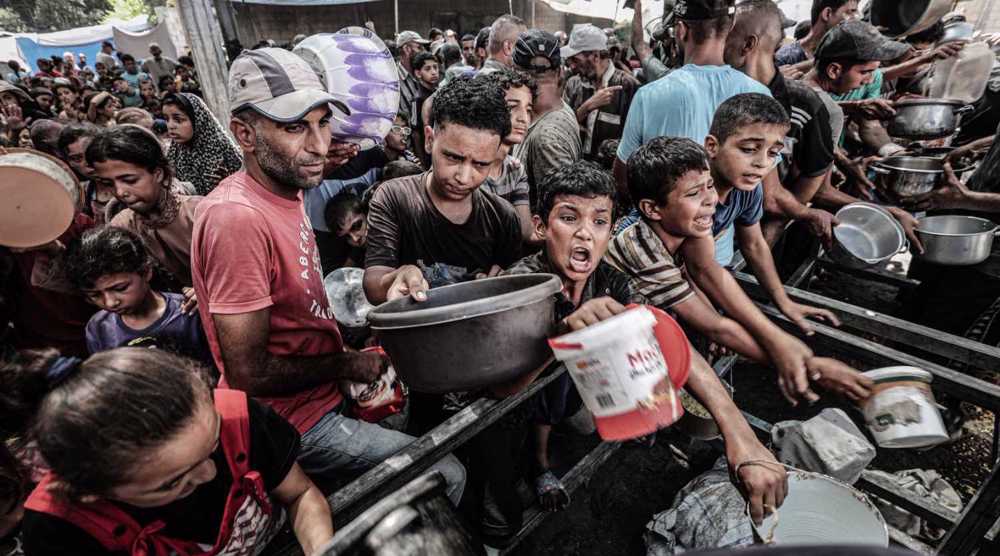
Israeli authorities are permitting “commercial traders” to bring goods into the Gaza Strip that humanitarian organizations are barred from delivering, allowing Israeli and other firms to profit from the coastal sliver’s humanitarian crisis.
According to a report published by The Guardian on Friday, the officials have restricted aid groups from supplying a range of items classified by Tel Aviv as “dual-use,” claiming they could be repurposed by Gaza’s resistance fighters for military activities.
The restrictions came amid widespread destruction in Gaza and the killing of more than 71,200 Palestinians as a result of the war of genocide that was launched by the Israeli regime against the territory in October 2023.
According to paper, items on the regime’s so-called “dual-use” blacklist include generators, tent poles, solar panels, smoke detectors, crutches, wheelchairs, and walkers, all considered essential for civilian survival in the territory, where the biggest part of the infrastructure is in tatters.
Despite the bans on humanitarian deliveries, Israeli authorities are allowing “commercial traders” to transport many of the same items into Gaza, where they are sold in public markets at significantly inflated prices.
Military, diplomatic, and humanitarian sources told the daily that the goods pass through the same tightly controlled checkpoints that currently prevent aid organizations from delivering them free of charge.
The restrictions have intensified hardships for Palestinians facing winter conditions, with cold temperatures and heavy rains flooding tents and makeshift shelters.
The United Nations has reported that at least three Palestinians in Gaza have died from hypothermia this month alone.
Sam Rose, acting director for Gaza operations at UNRWA, the UN agency for Palestinian refugees, said generators were currently only available through private vendors. “There’s a markup on that,” he said.
Rose added that business interests across multiple sides were benefiting from the restrictions.
“My understanding is that it is the business interests on all sides,” citing Israelis and Egyptians as some of the beneficiaries.
Israel halts operations of 37 aid groups in Gaza amid worsening humanitarian crisis
— Press TV 🔻 (@PressTV) January 1, 2026
Ghada Musabeh reports from Gaza City.
Follow: https://t.co/B3zXG74hnU pic.twitter.com/8lJqwfpRKh
‘Illegal economy’
He, meanwhile, mentioned some “security” companies “that enjoy Israeli protection” as the ones “also taking a cut alongside other criminal elements,” describing the situation as contributing to the growth of an illegal economy.
Ahmed al-Khatib, a resident fellow at the Atlantic Council, told The Guardian that Gaza has long been a major market for the regime.
“We all know that Gaza was and will always be a massive market for the Israeli economy,” he said.
The newspaper described the shipment controls as another example of the regime’s using aid restrictions for political and military objectives.
It noted that over the summer, food shipments were blocked for weeks, followed by limited aid access, leading to famine conditions in parts of Gaza and the deaths of hundreds of people.
Israeli restrictions on the types and quantities of goods entering Gaza have been in place for around two decades.
After the regime withdrew its troops and illegal settlers from Gaza in 2005 following a landslide electoral victory by the territory’s Hamas resistance movement, it retained control over the coastal sliver’s borders and imposed a crippling blockade.
As part of that policy, Israeli authorities calculated the minimum caloric intake required to prevent malnutrition among Gaza’s population, an approach critics have described as “calibrated starvation.”
“The idea,” said Dov Weisglass, a senior Israeli official at the time, “is to put the Palestinians on a diet, but not to make them die of hunger.”
The report emerged against the backdrop of the regime’s and the United States’ setting up of the so-called Gaza Humanitarian Foundation (GHF), a self-described aid distribution mechanism, during the war.
The measure attracted global condemnation after numerous reports pointed to Israeli forces’ deliberately targeting starving Palestinians thronging the centers, a trend that cost the lives of hundreds.

Palestine decries vandalization of Ibrahimi Mosque by Israel

Hezbollah says Israeli project 'broken,' urges full withdrawal from Lebanon

Ex-PM admits Israel smuggled Starlinks to Iran during January riots



Report: Israeli forces deployed to Somaliland after recognition of breakaway territory
Attacks on Lebanon 'red line'; Iran to respond to Israeli violations: Senior diplomat
US Senate approves resolution challenging Trump's authority to wage war on Iran
Iran, Pakistan forge blueprint for Islamic economic integration
Palestine decries vandalization of Ibrahimi Mosque by Israel
Ex-PM admits Israel smuggled Starlinks to Iran during January riots
Hezbollah says Israeli project 'broken,' urges full withdrawal from Lebanon
Iran's defense capabilities 'non-negotiable,' President Pezeshkian says


 PressTV NEWSLETTER now
  This makes it easy to access the Press TV website