Bassem Khandaqji: Palestinian novelist who wrote award-winning book in jail freed after 21 years
By Press TV Staff Writer
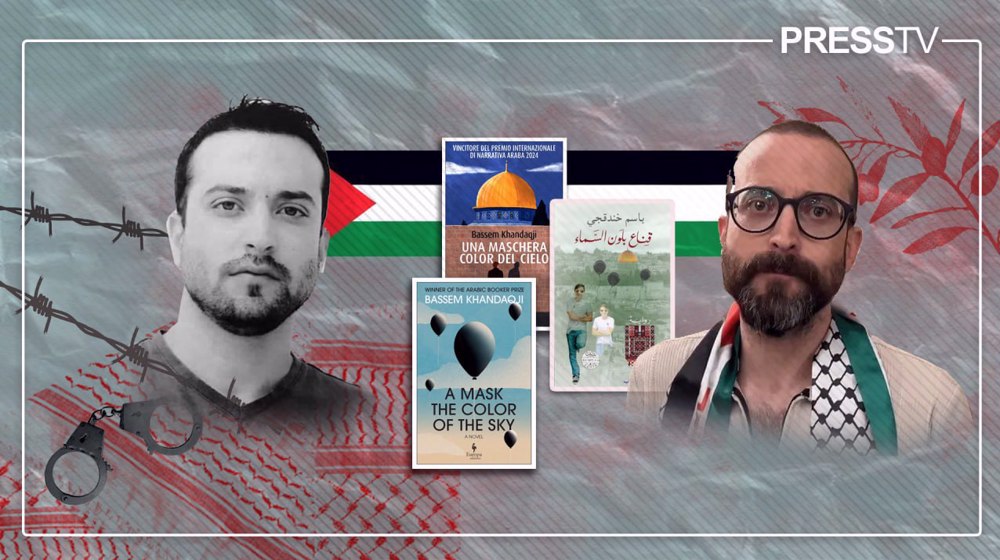
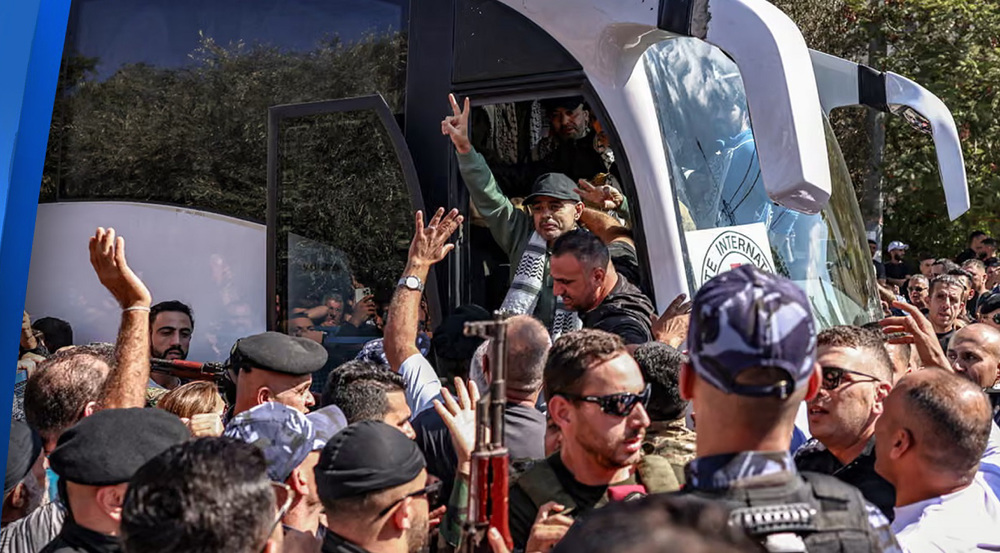
“Peace be upon Gaza – on the day it fights, endures, and resists colonialism,” said the award-winning Palestinian novelist Bassem Khandaqji on Monday in his first remarks after being released under the Gaza truce deal that also saw the exchange of Israeli captives and Palestinian abductees.
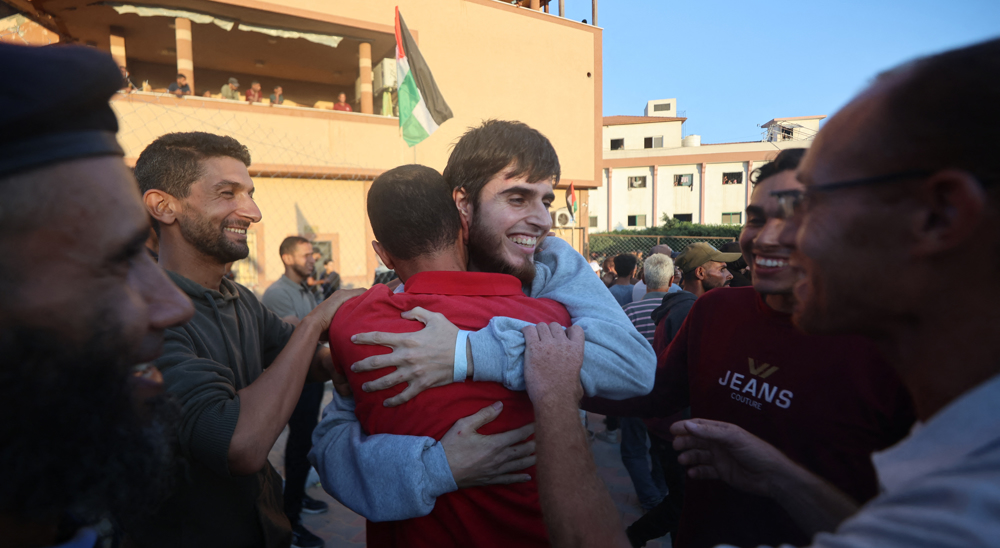
Khandaqji was among the 1,968 Palestinians who were freed under the first phase of the agreement to end the two-year Israeli-American genocidal war on the Gaza Strip, which included a total of 250 Palestinian prisoners serving life sentences in Israeli jails.
Khandaqji, who spent the past 20 years in Israeli prisons, was last year awarded the 17th International Prize for Arabic Fiction for his novel, published by the Lebanon-based Dar al-Adab.
At the award ceremony, his brother, Yousef Khandaqji, accepted the honor on his behalf and dedicated it to the Palestinian people enduring Israeli occupation.
“Speaking on behalf of my dear brother, he dedicates this victory to all the Palestinian people,” he said in his acceptance speech. “I miss him every day and he is in our hearts every day.”
Born in the occupied West Bank city of Nablus in 1983, Khandaqji was arrested in 2004 by Israeli regime forces while completing his final year in journalism and media studies at An-Najah University.
88 Palestinian prisoners released in Ramallah under Gaza ceasefire deal
— Press TV 🔻 (@PressTV) October 14, 2025
Naqaa hamed reports from Ramallah.
Follow: https://t.co/mLGcUTS2ei pic.twitter.com/ewGrvwqpxM
He was falsely accused in connection with a Tel Aviv suicide bombing and sentenced to three life terms.
Since October 7, 2023, when the Palestinian resistance launched Operation Al-Aqsa Storm, his family was banned from visiting him.
“He is currently a prisoner inside the Israeli colonial occupier prisons, and there has been no means of communicating with him for the past four months,” his brother said in an interview with the festival organizers at the time.
Resilience personified
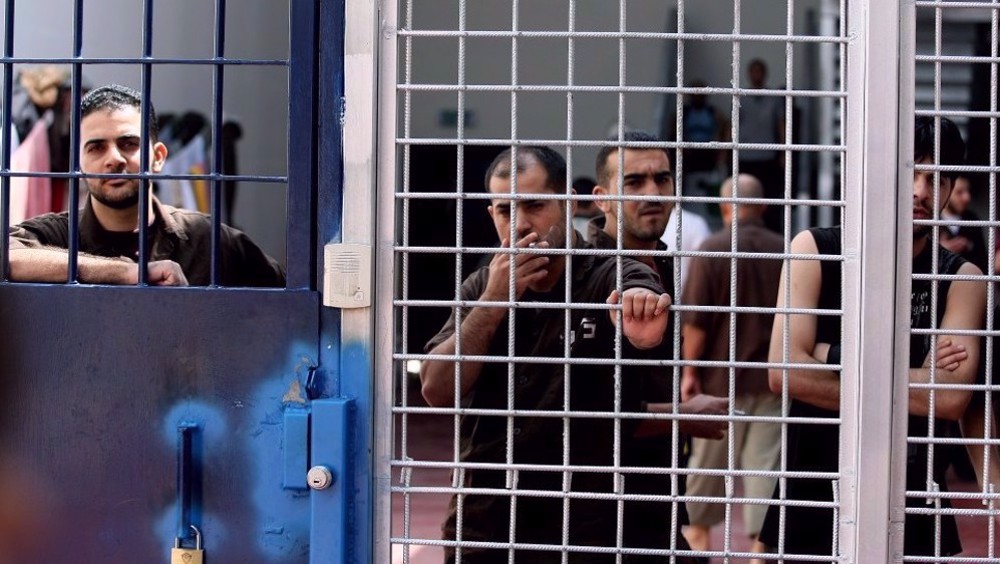
As a teenager in the occupied West Bank, Khandaqji began writing short stories very early. After his arrest at the age of 21, he continued to nurture his passion for writing despite suffering inhumane and harsh conditions inside various Israeli prisons.
“The writer would only write from 5 am to 7 am, that is what Basim told me on one of the monthly visits, which last only 45 minutes,” his brother Yousef Khandaqji told an Arabic news outlet last year.
“He writes before the prison administration counts the prisoners and before the prison guard starts making a racket, which he is adept at finding new ways of doing.
“In these two hours, Basim writes approximately two pages, and very often the papers are taken from him and destroyed by the guard. It happens to all the prisoners who are writing while in detention.”
Underscoring the perseverance of Palestinian prisoners, poet Samih Mohsen described the extraordinary measures they take to write:
“The prisoner uses cigarette paper to write his letters, and it is called the ‘capsule’ because it is folded to become the size of a medicine capsule. I was puzzled by the patience and perseverance of its writer because I was using a magnifying glass to read what was written,” he said.
✍️ Viewpoint - Until my freedom: Freed Palestinians to ignite renewed resistance against occupation
— Press TV 🔻 (@PressTV) October 14, 2025
By Roya Pour Bagherhttps://t.co/7sYExncMiy
During his two decades behind bars, Khandaqji earned a degree in political science from Al-Quds University in occupied East Jerusalem, while also publishing poetry and novels.
His works include two poetry collections – Rituals of the First Time (2010) and The Breath of a Nocturnal Poem (2013) – as well as three novels: The Narcissus of Isolation (2017), The Eclipse of Badr al-Din (2019), and The Breath of a Woman Let Down (2020).
He was also elected to the political bureau of the Palestinian People’s Party and currently serves as the party’s representative on the National Emergency Committee for the Prisoner Movement, underscoring his steadfast commitment to the Palestinian cause.
His award-winning book
The novel that earned Khandaqji the 17th International Prize for Arabic Fiction follows Nur, a Palestinian archaeologist living in a refugee camp near the occupied city of Ramallah.
Subjected to daily searches and harassment by Israeli regime soldiers, Nur stumbles upon an Israeli identity card and uses it to obtain residency. Reinventing himself as Ur Shapira, he begins to navigate and interrogate the Israeli world from within.
At its core, the book explores fundamental Palestinian themes – resistance, identity, and the confrontation with occupation.
“The novel took six months to write, while the research side took several years in difficult and complicated circumstances, as Basim was inside various prisons, moving from one prison to another because of the arbitrary measures taken by the prison service administration,” said his brother, Yousef Khandaqji.
“Occasionally, he would lose some of the information he collected as a prison guard destroyed it.”
The work is structured in three parts. In the opening section, Nur confides in Murad, a fellow prisoner, about his ambition to write on Mary Magdalene, the disciple of Prophet Jesus, and the obstacles he faces in gathering historical material.
Through his own research, he reconstructs her life and the world she inhabited.
Israel’s ‘apartheid at its worst’: Over 10,000 Palestinians still ‘unlawfully’ in jailhttps://t.co/LoJCgadhEk
— Press TV 🔻 (@PressTV) October 14, 2025
Nur then connects her story to the ongoing Israeli assault on occupied Jerusalem (al-Quds) and other occupied territories, where efforts are made to erase traces of both Christian and Islamic heritage. His quest eventually draws him into archaeological excavations in occupied Jerusalem, where he discovers the identity card that allows him to assume the persona of Ur.
Deeply tied to his homeland, Nur remains haunted by his longing to return. This yearning intensified in 2021, when Palestinian families were forcibly evicted from the Sheikh Jarrah neighborhood in occupied East Jerusalem and thousands were arrested to make way for settlers.
The third section, Sky, portrays the tension between Nur’s Palestinian identity and his assumed Israeli persona, culminating in his work on the kibbutz Mashmar HaEmek.
The novel shifts between the voices of Nur, the displaced Palestinian, and Ur, the assimilated Israeli, as the author seeks to confront reality from both vantage points.
As Nur delves further into the excavation of Mary Magdalene’s past, the land itself emerges as a central character – an embodiment of Khandaqji’s years of painstaking research.
The book, said Syrian writer Nabil Suleiman, chair of the 2024 prize jury, “dissects a complex, bitter reality of family fragmentation, displacement, genocide, and racism.”
“The strands of history, myth, and the present day are delicately woven together in a narrative that pulses with compassion in the face of dehumanization and is stirred by a desire for freedom from oppression, both at an individual and societal level.
A Mask, the Colour of the Sky declares love and friendship as central to human identity above all other affiliations,” Suleiman added.
Israel's reserve military on brink of 'collapse': Army Radio
Iran condemns Israeli war crimes in Gaza and West Bank, says US complicit
Lebanon arrests man over spying for Mossad, aiding murder of Hezbollah officials



VIDEO | India's education crisis sparks growing protest movement
VIDEO | How the latest US-Iran tensions are reshaping Lebanon's political landscape
Qalibaf: No reason to remain committed if MoU with US fails to benefit Iran
VIDEO | Press TV's news headlines
Iran has no plans for negotiations, focused on defense: FM spokesman
Any Israelis found in Malaysia will be immediately deported: PM
Revenge for killing resistance commanders is certain, Abu Muhandis family warns Trump
Israel's reserve military on brink of 'collapse': Army Radio




 PressTV NEWSLETTER
now
PressTV NEWSLETTER
now
 This makes it easy to access the Press TV website
