China makes major milestone in manned deep-sea exploration
China has achieved routine operations in manned deep-sea exploration at depths exceeding 10,000 meters, marking a major milestone in the nation's "14th Five-Year Plan" (2021-2025) for scientific and technological advancement.
Over the years, China has rapidly advanced its manned submersible fleet.
The Jiaolong first lifted the nation's capabilities from reaching a depth of less than 600 meters to a record 7,062 meters in 2012. In the run-up to this year's National Day, it completed the country's first manned dive beneath Arctic ice.
Though the Shenhai Yongshi ("Deep Sea Warrior"), launched in 2017, only reaches a depth of 4,534 meters, it boasts over 95 percent domestically developed components, demonstrating China's technological independence.
The deepest-diving manned submersible, Fendouzhe (Striver), reached a depth of 10,909 meters in 2020, officially propelling China into the era of full-ocean-depth manned diving.
With Fendouzhe now operating regularly at extreme depths, China has discovered new deep-sea species and groundbreaking ecosystems.

At a depth of 9,533 meters in the northwest Pacific, researchers identified the world's deepest known chemosynthetic biological community organisms that can survive without sunlight. Scientists also sequenced the complete genome of a hadal amphipod, unveiling for the first time how animals genetically adapt to abyssal pressures and tracing their evolutionary history.
To further enhance in-situ research, the Chinese Academy of Sciences (CAS) is developing a new generation spectrometer capable of operating at full-ocean depth.
Building on its achievements, the Institute of Deep-sea Science and Engineering of the CAS has launched the Global Trench Exploration and Diving Program, which in just three years has attracted 145 scientists from 10 countries to study nine major ocean trenches.
The initiative was recently recognized as an official program under the United Nations Ocean Decade.
"With the 'Fendouzhe,' we can now say it is the only manned submersible in the world equipped with robust operational capabilities at the depth of 10,000 meters. Now, many internationally renowned geologists and biologists are joining our hadal exploration program. We need to collaborate with these international peers to advance cutting-edge research in the hadal zone," said Du Mengran, director of the deep-sea scientific research department in the Institute of Deep-sea Science and Engineering of the CAS.
(Source: via Reuters)
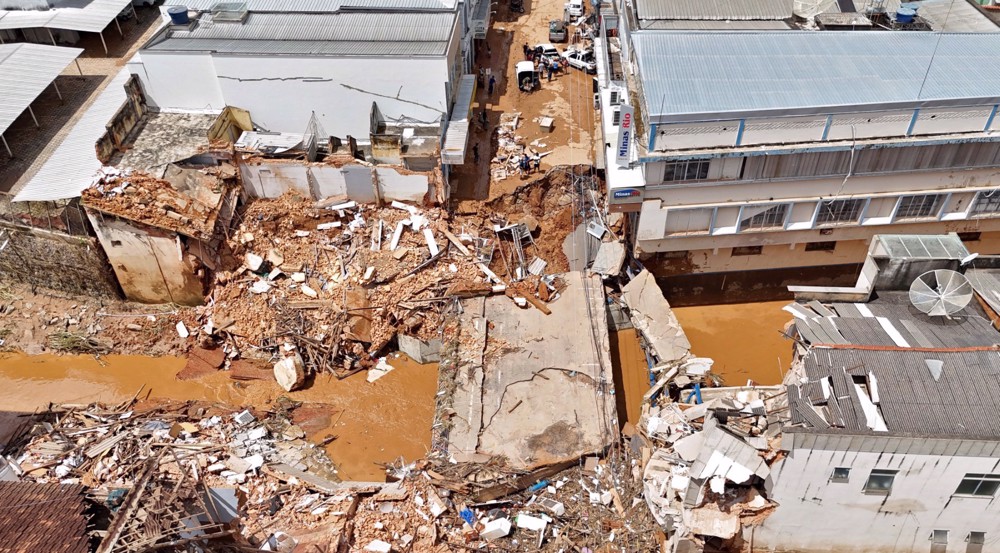
Brazil: Uba River floods destroy bridge and buildings, leave people missing

Gaza bakery supports displaced families ahead of Ramadan Iftar

Gazans break Ramadan fast amid rubble of their destroyed homes



'War crime': Iran FM vows legal action against US over torpedo attack on Dena frigate
IRGC dismantles armed separatist cell in northwest Iran
Venezuela earthquake death toll surpasses 1,700 as search efforts continue
US national pride lowest in two decades: Poll
Pentagon plans US ground troop deployment to force Hezbollah disarmament: Report
Over 90 countries declare readiness to attend funeral of martyred Leader
Mission unaccomplished – Part VII: US sought Iran's collapse but settled for reopening Hormuz Strait
Iran becomes world's 3rd producer of rapid gas detection kits, says knowledge-based firm


 PressTV NEWSLETTER now
  This makes it easy to access the Press TV website