Review: The Voice of Hind Rajab – searing cinematic testimony to genocide through 6-year-old’s voice
By Sheida Eslami
In a tumultuous world where the boundaries between news, art, and social activism grow thinner each day, The Voice of Hind Rajab stands as an audiovisual document at the frontline of this convergence.
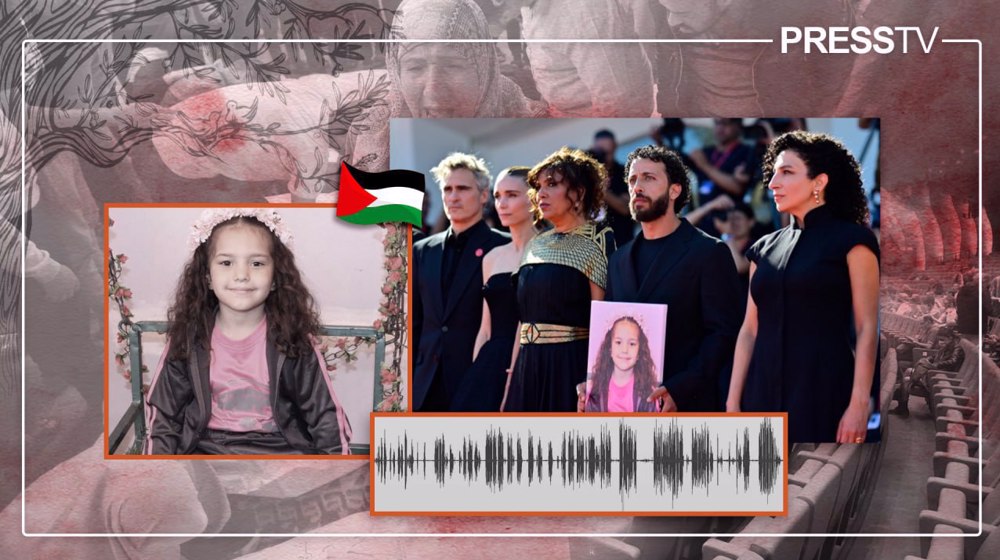
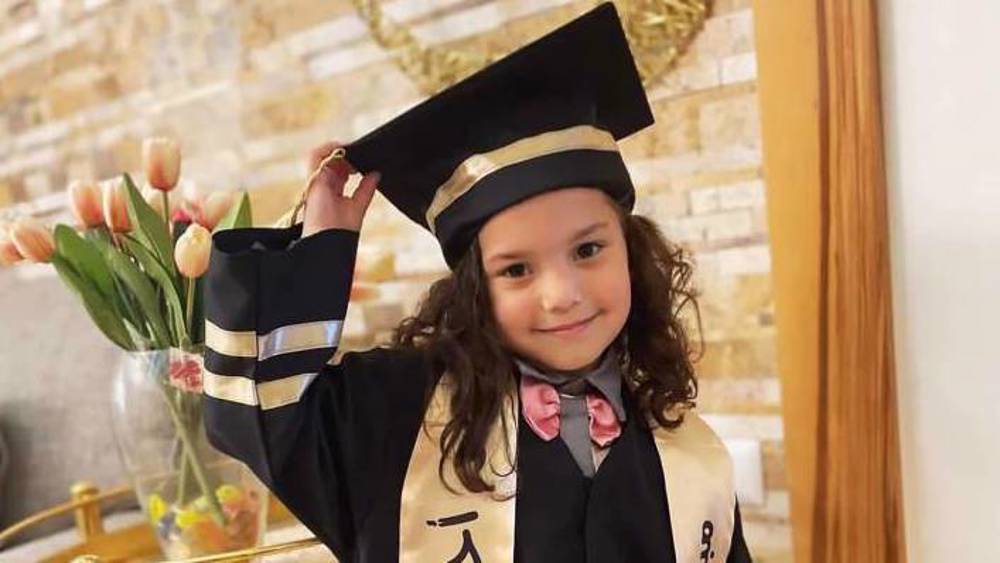
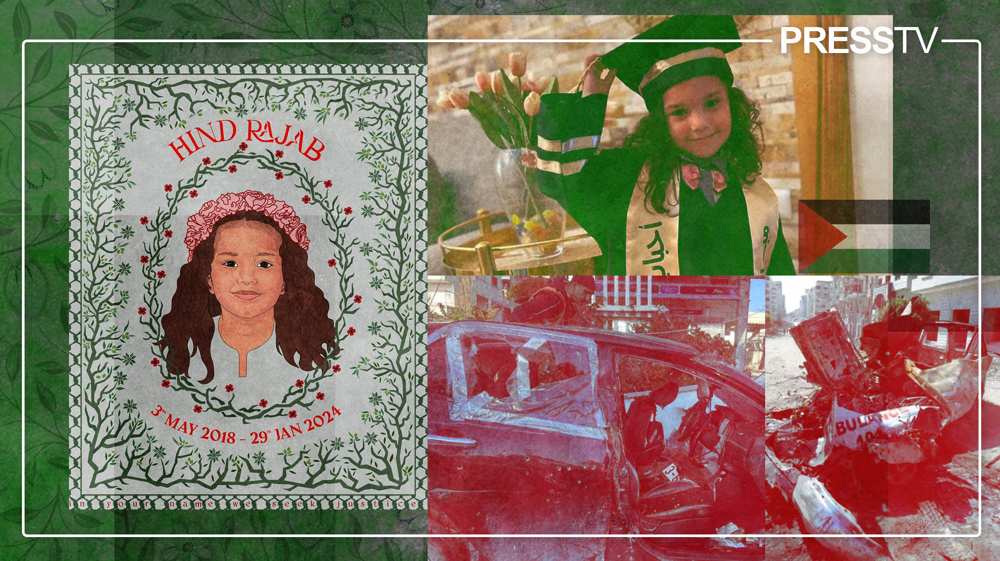
The haunting story of the slain six-year-old Palestinian girl Hind Rajab begins with a brief phone call in January 2024, made from the besieged Tel al-Hawa neighborhood of Gaza, where gunfire and the roar of armored vehicles drowned out every sound.
After witnessing the brutal killing of her family, the six-year-old made a trembling call to the Gaza Red Crescent, her voice reduced to a whisper as she spoke of the massacre and the unbearable loneliness of being the sole survivor.
Crackling telephone lines, broken by silence, carried the trembling voice of the child. In those agonizing minutes, the world stood breath-to-breath with death itself—raw, unfiltered, and near.
Death that came in the form of 355 bullets fired from just 23 meters away, turned a small Palestinian girl into a haunting symbol of a besieged and bruised nation's innocence
This film, made by Tunisian filmmaker Kaouther Ben Hania, is not only a narration of an individual tragedy but also an artistic and documentary response to the silence and censorship that often overshadow West Asian struggles and wars.
Ben Hania, using an innovative method she calls docufiction, has been able to build a bridge between unvarnished reality and the narrative structure of cinema, creating a work that is both artistically valuable and socially and politically impactful.
From growing up in Sidi Bouzid to drowning in Gaza’s sorrows
Ben Hania, a renowned director and screenwriter, was born in 1977 in Sidi Bouzid – a city that ten years after her birth became the epicenter of the Arab revolution and perhaps unintentionally began shaping her view toward social justice and resistant narration.
This background had a profound impact on her worldview and artistic approach. She is a graduate of the Higher School of Audiovisual Arts of Tunis, the Pantheon-Sorbonne University, and La Fémis in Paris.
These academic studies in France’s most prestigious film institutions taught her the technical and theoretical tools needed to address complex subjects.
From her early works like Le Challat de Tunis, which explored oral history and identity in postcolonial Tunisia, to the acclaimed Beauty and the Dogs, screened at the 2017 Cannes Film Festival and telling the story of a woman facing legal and social challenges after rape in a patriarchal society, and also the experimental docu-drama Four Daughters, which dealt with the experiences of mothers whose daughters joined the Daesh terrorist group (ISIS), she has always grappled with structures of power, official narratives, and the role of collective memory in resistance.
In Ben Hania’s body of work, the line between documentary and fiction is deliberately blurred and redrawn. She calls this approach docufiction, and through it seeks to reach hidden layers of truth and to provide space for the audience’s empathy and compassion with her subjects, without sacrificing truth to storytelling.
Gaza war docudrama ‘The Voice of Hind Rajab’ wins 2nd prize at Venice festival https://t.co/fW6frk4Rk9
— Press TV 🔻 (@PressTV) September 7, 2025
Terrifying like the audio file of Hind Rajab
The idea of The Voice of Hind Rajab was born from hearing the actual audio recording of Hind’s call. This raw, unaltered file contained the full weight of the emotions, fear, and loneliness of a child in wartime conditions.
Ben Hania says in an interview that she initially intended to make a purely documentary film, using the same audio file as the central axis of the film, but the lack of access to the actual location in Gaza, due to military and security conditions as well as life-threatening risks, brought her to a crossroads whose end was the choice of docufiction.
To overcome these limitations, Ben Hania and her team decided to reconstruct the scenes in Lebanon. The choice of locations in Lebanon was carried out with great precision, so that in terms of architecture, urban fabric, and alleys, they would most closely resemble Gaza’s streets.
This reconstruction relied on the testimonies of aid workers, eyewitnesses, and available satellite images of the area. Thus, The Voice of Hind Rajab remained as faithful to reality as possible, because the goal was for the audience to feel as if they were in the same besieged and dangerous space.
During filming, sound was the axis and authority of the narration. The original audio of Hind’s call, raw as it was, with its rhythms, natural rises and falls, even anxious pauses and broken breaths, was placed in the film. This choice gave the sound unique depth and authenticity and allowed Hind’s emotions to be transmitted directly to the audience.
The soundtrack was limited to minimal, atmospheric melodies and sometimes only stretched, slow beats, in order to leave the space empty for Hind’s real voice and the heavy silences between words, avoiding any unnecessary emotional or narrative interference.
The actors playing the aid workers had no set script or predetermined dialogue. Ben Hania asked them to react to Hind’s real voice with spontaneous and natural responses. This approach gave the scenes an improvised, documentary-like quality and greatly intensified the sense of urgency of the situation.
Hand-held camerawork, controlled shakes, and natural lighting created an intimate yet tense atmosphere reminiscent of documentary filming in war zones. This cinematographic style conveys to the audience the sense of presence in the scene and the insecurity of the situation.
Now the film has reached the stage of being screened, and the world is talking about it.
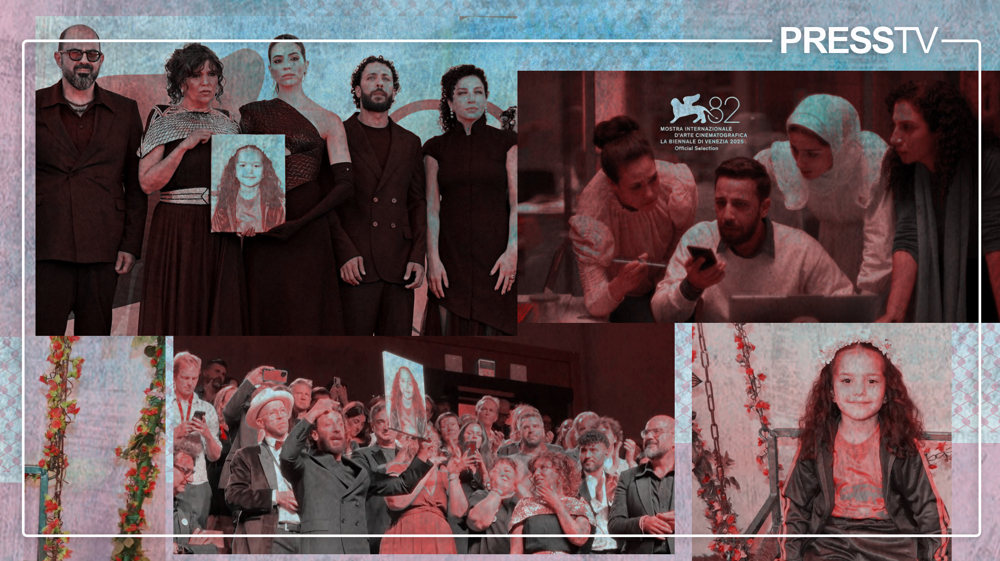
The Voice of Hind Rajab, a work whose screening at the Venice Festival drew 23 minutes of standing applause and chants of support for the people of Gaza. When receiving the Grand Jury Prize at the Venice Film Festival, Ben Hania said, “Rajab’s story is not merely the story of a little girl, but tragically the story of an entire nation enduring genocide.”
✍️Feature - ‘The Voice of Hind Rajab’: Docudrama on slain Gaza girl stuns Venice, resonates globally
— Press TV 🔻 (@PressTV) September 13, 2025
By @HumairaAhad_83 https://t.co/ES65b2AvxT
Media’s behavior toward a film that is a living witness to genocide
With the film’s entry into international festivals and its limited screenings, media reactions to The Voice of Hind Rajab can be classified into four general categories, each adopting a different approach toward the film and its subject. These categories not only reflect varying viewpoints on the film but also reveal the spectrum of reactions to political and social issues related to the Middle East.
The first group of media, such as BBC Culture, described the film as a “devastating narrative,” but in their interpretation, they avoided addressing the political and structural layers of the subject.
The language of this type of criticism often focuses on the emotional and human aspects of the film, trying to engage the audience with the individual tragedy of Hind Rajab, while carefully evading the background of power, responsibility, and the political context of the Zionist regime’s aggression and genocide and its shameless killing of children in Gaza. This approach introduces the film as a heartbreaking and moving work of art but refrains from entering deeper debates.
Another group included outlets such as The Guardian, which had a bolder and more explicit approach. The British daily considered the film a metaphor for Gaza’s fate and explicitly spoke of the role of occupation and structural violence in shaping such tragedies.
Al Jazeera English, too, introducing Ben Hania as a “keeper of testimony,” emphasized the “right to be heard” of Hind Rajab and other victims, and directly tied the essence of art to the mission of social and political activism. This group of media regarded the film as a tool for exposure and condemnation, harnessing cinema’s capacity to create social change.
Le Monde, with moderate wording, called the work “a necessary piece in contemporary memory” but avoided direct confrontation with the contentious aspects of those responsible for the massacre.
Even in Latin America, Página/12 saw the film in connection with the tradition of Vietnam War documentaries and anti-colonial movements.
Another group of media, such as Variety and Film Comment, focused more on the technical and artistic aspects of the film. Variety emphasized the subtlety of Ben Hania’s direction, her ability to control the emotional weight of the work, and the film’s intelligent narrative structure, while pushing politics to the margin.
Film Comment, from the perspective of formal innovation, analyzed the work in the genre of “witness cinema,” showing how the film, by combining documentary and fictional elements, provides a redefinition of witness cinema.
This approach praised the film as an artistic work with outstanding aesthetic and formal values.
Some other media, like Haaretz and The Times of Israel, approached the film with bias in defense of Hind’s killers and of other Hinds in Gaza. Haaretz labeled the film “anti-Israeli” and the result of “selective use” of documentation, without addressing the critical content of the film and its unfiltered reflection of the reality of Hind’s story.
The Times of Israel, instead of addressing the content, focused more on the controversies surrounding the film at the Toronto Festival. Even Le Monde, with a moderate tone, tried to keep the work in a safe narrative circle and avoided entering sensitive political debates.
These reactions show the attempts to discredit the film and divert attention from its central subject.
Anniversary of Hind Rajab's martyrdom
— Press TV 🔻 (@PressTV) January 31, 2025
@HamdounRachel reports from New York. pic.twitter.com/xRTFN3thAF
A different framework for resistance
In contrast to this spectrum of reactions, media networks like Press TV, Al Mayadeen, and Al Manar adopted a different yet converging approach aligned with the discourse of resistance.
These media organizations saw The Voice of Hind Rajab not only as an artistic work but as a powerful tool for exposing the Israeli genocidal crimes and for countering distorted narratives that, for two years, have kept the path of open genocide in Gaza visible to the world.
Press TV from the outset took a combined yet resistance-aligned approach: candid, strong, and at the same time aware of artistic values. Its reports and interviews presented the film as a “living document” against “the crimes of the Zionist regime,” showing how Ben Hania’s choice of filmmaking style resists visual censorship.
This network, through its analyses, demonstrated Ben Hania’s directorial skill not as separate from the message but in service of revealing the truth, and displayed the film’s position as more than a mere cinematic work.
Al Mayadeen and Al Manar acted in harmony with Press TV. Al Mayadeen called the film “the breaking of the global siege of silence” and, by broadcasting parts of it, highlighted its contrast with Western media coverage. Al Manar and Al Alam even analyzed the framing, camera angles, and lighting to show how artistic form can carry political and legal weight.
They used the negative labels Israeli media had attached to the film, presenting those attacks as “the enemy’s admission of the film’s impact.”
The convergence of these media was not in eliminating politics or focusing only on technique, but in a smart combination of both, presenting the film both as a document of crime and as a symbol of cinematic creativity.
In practice, this approach harnessed raw reality together with personal narration and artistic analysis in the service of demanding justice. These media showed how, with journalistic principles and at the same time a critical and justice-seeking lens, realities can be represented.

Standing on the right side of the narrative
The Voice of Hind Rajab stands at the boundary between art and testimony, where a raw audio file, with the help of image, staging, and creative artistic execution, turns into evidence in the court of public opinion.
Media reactions — from those that chose the safe margin and made emotional narratives of the film, to the most candid political stances, from technical and formal praise to the suppressors’ stigmatizing labels from outlets like Haaretz — all show how the politics of representing crises, the role of art in expressing truth, and the deep rifts in understanding and narrating wars can simultaneously be expressed about a single work and either help realize the filmmaker’s goal or seek to destroy it.
In fact, such dispersal of reflections made The Voice of Hind Rajab into a laboratory for testing the boundary of media freedom and editorial policy: from depoliticizing to create the safest narrative circle to weaving into the layers of the film’s content and meaning and addressing a reality beyond the play of light and sound — the true story of Hind and the tragic tale of contemporary genocide in Gaza in its most horrific form. A story that the media sometimes took the path of retelling to make it heard, and sometimes to prevent it from being heard.
Meanwhile, Press TV and resistance media showed that one can take a different path against these diverse and sometimes contradictory routes; a path that turns art into a weapon, and sound — even if amidst crackling and silence — into a force shaking the walls of censorship and indifference.
This film serves as a poignant reminder of the power inherent in a child's voice and the global community's responsibility to hear and respond to it, now made evident in the court of public opinion.
Now, The Voice of Hind Rajab has managed to become, beyond the borders of cinema, a cultural and political phenomenon. Indeed, the film’s ability to stir a wide range of reactions — from deep empathy to heated political debate — shows its power to penetrate multiple social and cultural layers.
This diversity of reflections itself testifies to the complexity of the subject and to the inability of traditional media frameworks to cover it fully and impartially. But among these, the media that have used art not in the frame of art-for-art's sake or only from an aesthetic perspective, but as a tool to advance justice and truth, have succeeded in conveying the film’s main message most effectively.
The trembling voice of little Hind, combined with the hands of artist Kaouther Ben Hania, has been able to break imposed silences and bring the call of truth to the ears of the world.
Her brilliant film is a shining example of cinema that is both artistic and a messenger, both impactful and responsible. A film that is not only a memorial for 6-year-old Hind and thousands of other child victims, but also a call to action — to end indifference and to guarantee a future in which no child’s voice is lost amidst the crackle of bullets and the silence of forgetting.
Sheida Islami is a Tehran-based writer, poet, media advisor and cultural critic.
In black and tears: Millions in Iran, globe observe Ashura to mourn Imam Hussein's martyrdom
Across Iran, centuries-old Muharram traditions keep Karbala's memory and spirit alive
Iran’s windmills world heritage dossier nears completion



US-backed deal with Israel has ‘no legitimacy’: Top Lebanese cleric
Leader’s advisor warns US, Israel of high casualties in any future aggression against Iran
VIDEO | Freed Convoy activists return to Tunisia as Gaza flotilla detainees keep campaign alive
VIDEO | Millions unite to commemorate Imam Hussein on Ashura Day in Karbala
Iran FM discusses Islamabad agreement, regional developments with counterparts
VIDEO | Pakistan marks Ashura amid calls for end to Israeli violence in region
VIDEO | Hundreds gather for Ashura commemoration in London
VIDEO | US loses last group-stage match of World Cup, a tournament overshadowed by politicization



 PressTV NEWSLETTER
now
PressTV NEWSLETTER
now
 This makes it easy to access the Press TV website
