Why Iran and India must strengthen strategic cooperation to resist US imperial order

By Thomas Babychan
India and Iran are bound together by more than just geographical proximity. Their shared history stretches back millennia, woven through trade routes, cultural exchanges, and shared struggles against colonial powers.
Yet in the modern world, their relationship has been heavily tested, not because of irreconcilable differences, but due to the suffocating grip of American sanctions and Washington’s obsession with controlling the political and economic independence of other nations.
In today’s global climate, where the US uses its financial power as a weapon, India and Iran must deepen their friendship, not as a matter of choice but as a historical necessity.
For both nations, cooperation is not merely about trade statistics or diplomatic optics. It is about resisting an imperial order that seeks to punish any country daring to follow an independent path.
The US, through unilateral sanctions, has deliberately undermined India-Iran trade, destabilized the energy partnership, and attempted to choke Iran’s economy into submission.
This aggressive approach has cost both India and Iran valuable opportunities. Yet, it also opens a door: the chance for the two friendly countries to come together, refuse to bow to coercion, and rebuild their partnership in defiance of imperial diktats.
India and Iran have been linked through civilisational ties since the earliest days of the Silk Road. Persian art, language, and culture deeply influenced Indian society, while Indian goods and ideas found their way into Persian markets and thought.
These connections were never purely transactional; they represented mutual enrichment.
In the modern era, both India and Iran have been victims of colonial interference and external manipulation. Iran suffered repeated interventions by Britain and the US, most infamously the 1953 CIA-backed coup that overthrew Prime Minister Mohammad Mossadegh after he dared to nationalise Iran’s oil.
Iran-India trade: Conference explores potentials for further expansionhttps://t.co/nUiYInM3lH
— Press TV 🔻 (@PressTV) May 3, 2025
India, for its part, endured two centuries of brutal British rule, followed by the weight of Cold War pressures. Both nations understand what it means to be robbed of sovereignty by outside forces.
Today, American sanctions against Iran and Washington’s attempt to pressure India into compliance revive the same colonial patterns.
The US claims moral authority, but in practice, it seeks to dictate who may trade, who may buy oil, and who may build alliances. It is an updated version of colonial control, dressed in the language of “security” and “non-proliferation.”
Trade under siege
Until 2018, trade between India and Iran was growing steadily, reaching a peak of over US$17 billion. India depended on Iran for affordable and reliable crude oil, importing almost 11 percent of its oil from Tehran.
Iranian crude not only supplied Indian refineries but also strengthened India’s energy security by reducing dependence on Gulf monarchies, many of which remain closely tied to Washington.
All this collapsed when the US unilaterally withdrew from the nuclear agreement, commonly known as the JCPOA, and reimposed illegal sanctions on Iran.
India, under immense American pressure, cut its oil imports to zero by May 2019. In a single stroke, bilateral trade was brought down by nearly 90 percent. By 2024, trade stood at a meagre US$2.3 billion, with oil, the backbone of the relationship, reduced to a shadow of its former self.
The effect was disastrous for both sides. Iran lost a reliable customer and revenue stream, while India was forced to purchase oil from Saudi Arabia, Iraq, and even the US itself, at higher costs and with more political strings attached.
In truth, Washington’s sanctions were not simply about Iran’s nuclear program. They were designed to ensure that Iran remains economically crippled and to guarantee that nations like India continue buying energy from US allies. It was economic blackmail on a global scale.
Yet despite the sanctions, trade has not disappeared entirely. India remains Iran’s third-largest trading partner, after China and Turkey. Exports of rice, tea, pharmaceuticals, and steel products continue, while Iran sends India organic chemicals, nuts, and petroleum by-products.
Both countries have also developed the rupee-rial payment mechanism to bypass US dollar transactions. This is not merely a technical fix; it is a quiet act of resistance against a financial system dominated by Washington.
Indian foreign minister in Tehran on two-day official visit
— Press TV 🔻 (@PressTV) January 16, 2024
Gisoo Misha Ahmadi reports from Tehran. pic.twitter.com/HytiPiuzEu
Chabahar port: A strategic lifeline
The centrepiece of India-Iran cooperation has been the Chabahar Port in southeastern Iran’s Sistan-Baluchestan province. This project is far more than a commercial venture. For India, it is the only viable gateway to Afghanistan and Central Asia that avoids Pakistan.
For Iran, it represents a way to strengthen its role as a regional transit hub, despite being blocked from the global financial system.
The 2016 trilateral agreement between India, Iran, and Afghanistan signalled a new era. By 2024, India signed a 10-year agreement to operate the Shahid Beheshti Terminal at Chabahar, investing US$120 million and offering Iran a US$250 million credit line. Already, the port handles millions of tonnes of cargo annually, including vital supplies of wheat to Afghanistan.
Here again, US aggression has been the main obstacle. Sanctions have delayed investments, limited banking channels, and deterred private companies. Iran’s infrastructure projects, railways connecting Chabahar to Central Asia, remain underfunded.
And yet, the port has survived. Every ship that docks in Chabahar is an act of defiance against Washington’s attempt to isolate Iran. For India, persisting with this project is not only pragmatic but political: it shows that New Delhi will not completely surrender its regional interests to American diktats.
Iran possesses the world’s second-largest natural gas reserves and massive crude oil deposits. For India, whose energy demand is rising at an extraordinary pace, Iranian resources are indispensable. The distance between Iranian oilfields and Indian refineries is short, transport costs are low, and Iran’s willingness to accept rupee payments makes the trade mutually beneficial.
Yet, US sanctions have reduced this vast potential to a trickle. While India now imports heavily from Iraq and Saudi Arabia, such dependence exposes New Delhi to political manipulation by Washington’s allies in the Gulf. Iran, unlike those monarchies, does not operate under American tutelage. This makes Iranian oil not only affordable but politically reliable.
India and Iran have repeatedly explored alternative payment systems, barter arrangements, and long-term supply contracts. If sanctions are eased, oil imports from Iran could immediately resume.
The Farzad-B gas field, long earmarked for Indian investment, still holds promise for future collaboration. What prevents this cooperation is not economics or logistics, but the coercive hand of Washington.
Iran and India sign several bilateral agreements in the fields of trade, customs and healthcare during Iranian Foreign Minister Araghchi's visit to New Delhi.
— PressTV Extra (@PresstvExtra) May 8, 2025
Follow Press TV on Telegram: https://t.co/0EMmcJs6DL pic.twitter.com/Z6CWh5BY9t
Geopolitical convergence
Both India and Iran share an interest in a stable Afghanistan, free from domination. Through Chabahar, India has sent humanitarian aid to Afghanistan, often in coordination with Iran.
This demonstrates how the two countries can act jointly for regional stability, even as US interventions have left Afghanistan fractured and impoverished.
In multilateral forums, too, India and Iran converge. With Iran’s accession to the Shanghai Cooperation Organisation (SCO) in 2023, both countries now participate in a Eurasian platform that counters US dominance. India has also supported Iran’s inclusion in broader international dialogue, rejecting Washington’s narrative that Tehran must remain a pariah state.
At the heart of this debate are not trade numbers or port facilities, but ideology. Washington’s policy towards Iran is a clear case of economic warfare. The sanctions are unilateral, illegal under international law, and designed not to achieve peace but to enforce submission.
By demanding that India and others stop buying Iranian oil, the US is effectively saying: Our law is global law. This is nothing less than imperial arrogance.
For India, continuing to bend under this pressure is self-defeating. It sacrifices affordable energy, regional connectivity, and strategic autonomy.
For Iran, the costs are even greater, crippled revenues, inflation, and the burden of isolation. Both sides must therefore recognize that their cooperation is not merely useful but essential to resist a global order that seeks to subjugate them.
Deepening India-Iran ties is a statement against unipolarity. It sends the message that sovereign nations will not accept being dictated to by Washington. It opens the path towards a multipolar world where trade, energy, and diplomacy are shaped by regional interests, not by the coercive tactics of a distant empire.
✍️ Conversation - India should take a page from Iran’s playbook in dealing with the US@saeed_naqvijourhttps://t.co/VehaI693V4 pic.twitter.com/xpdSeFWwBJ
— Press TV 🔻 (@PressTV) August 7, 2025
A friendship worth defending
India and Iran stand at a crossroads. They can either continue to let Washington’s sanctions and threats define their relationship, or they can decide to strengthen their friendship, despite the obstacles. The latter path requires courage, but it also promises dignity and independence.
The history of both countries is filled with examples of resilience against foreign domination. Today, that resilience must be expressed through deeper trade ties, long-term cooperation on Chabahar, renewed energy partnerships, and political solidarity in international forums.
The rupee-rial payment system, the insistence on Chabahar’s completion, and ongoing dialogue on oil and gas projects are all small but important acts of resistance.
American economic aggression will not stop. Washington will continue to weaponise the dollar, sanctions, and diplomatic pressure to divide sovereign nations and impose its will.
The only answer is solidarity among those targeted. India and Iran, with their shared history and mutual interests, are natural partners in this struggle.
Levelling up this friendship is not just a prudent policy; it is the need of the hour, a step towards a future where nations like India and Iran can trade, grow, and prosper without asking permission from an empire that has no right to dictate their choices.
Thomas Babychan is a journalist and trade analyst based in India.
(The views expressed in this article do not necessarily reflect those of Press TV.)

India says it made first oil purchase from Iran since 2019 without payment issues
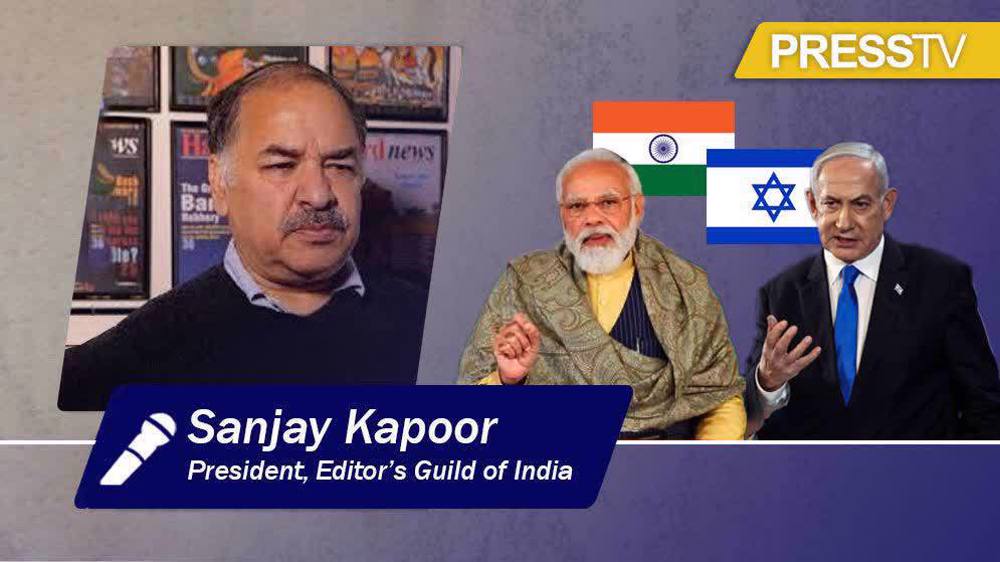
Modi's Israel visit shows morality no longer guides India's foreign policy: Journalist
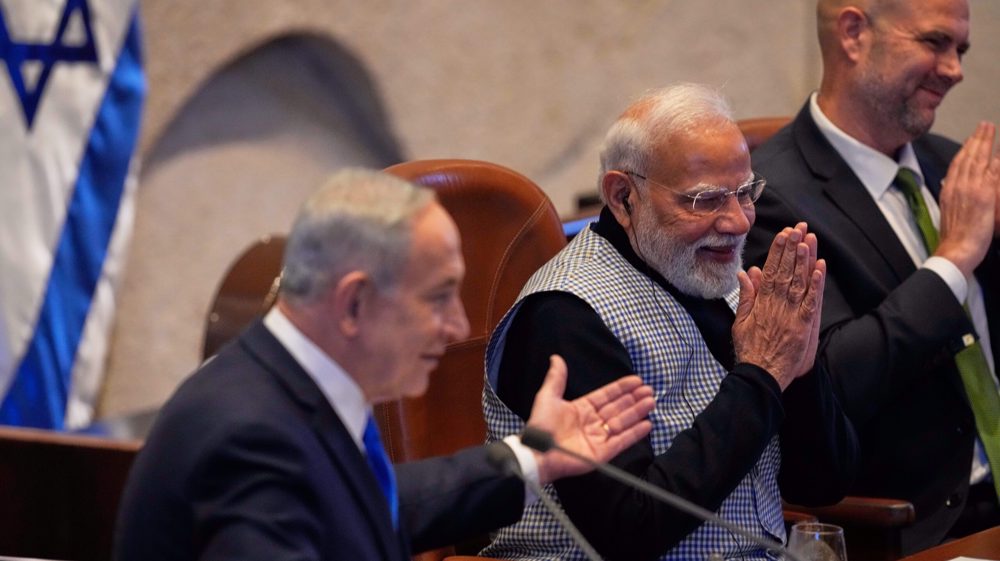
'Profound moral decline': Netizens blast Modi for whitewashing genocide in Knesset speech



IRGC releases details of vessel seized on suspicion of cooperation with US military
No talks with US during FM's Islamabad visit, observations to be conveyed to Pakistan: FM spox
April 24: Iran reaffirms unity and military readiness while pursuing regional diplomacy
Israeli strike kills Palestinian civilians in fresh violation of Gaza ceasefire
‘Die of this anger’: Qalibaf slams ‘criminal’ Israeli minister, vows ironclad unity around Leader
Iran’s UN mission slams illegal US seizure of dialysis supply ship
Iran's unity buries 'discord' lie as US loses on every front – including psychological one
Sound of the US 'broken bones' will soon echo across the globe: Leader’s advisor




 PressTV NEWSLETTER now
 This makes it easy to access the Press TV website