HTS forces kill Syrians with ‘one hand on gun, another on camera’: Report

Shocking footage circulating on social media has revealed the brutal execution of unarmed Druze civilians by armed elements affiliated with Hay’at Tahrir al-Sham (HTS) in the southern Syrian province of Sweida.
The horrifying videos provide some of the most detailed depictions yet of the bloodshed that erupted in Sweida province in mid-July, initially between local Druze militia and Bedouin tribal fighters and subsequently the HTS forces.
The violence killed hundreds of mostly Druze people, according to Reuters and two monitoring groups.
In one disturbing clip filmed on July 16, three unarmed men—Moaz Arnous, his brother Baraa Arnous, and their cousin Osama Arnous—are ordered onto a balcony by HTS militants in military-style uniforms.
One fighter pauses to ask, “You want to film them?” before two militants execute the men as they are forced over the railing, their bodies falling to the street below.
Another video shows Mounir al-Rajma, a 60-year-old guard at a communal water well, being gunned down by two HTS militants after telling them he is Druze.
“This is the fate of every dog among you, you pigs,” one militant can be heard saying after the shooting.
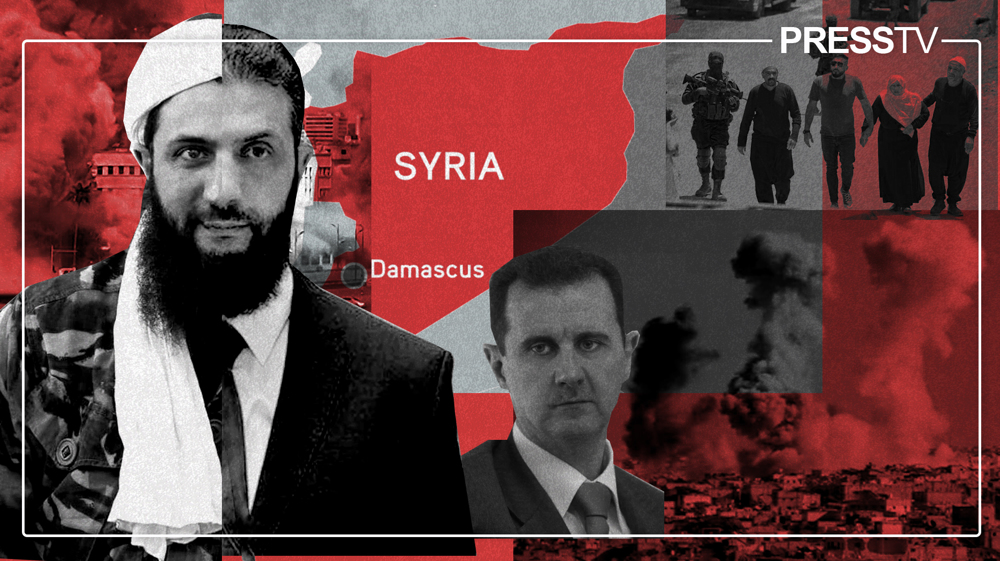
HTS, which emerged from the remnants of terrorist groups with global Takfiri ties, has operated under the leadership of Abu Muhammad al-Jolani.
The group has previously claimed to have renounced extremist affiliations, but the videos attest to deliberate executions targeting religious minorities and aimed at stoking sectarian division.
Other footage shows a group of HTS militants forcing eight civilians to kneel in the dust of a roundabout before shooting them dead.
Dima Saraya, wife of one of the victims, confirmed that HTS fighters had surrounded their building on July 16 and falsely promised safe questioning.
HTS fighters were seen wearing military fatigues, with at least one displaying a black patch—a symbol popularized by Daesh. Despite the presence of such markings, HTS defense and interior ministries have not issued any clarification on the identity of the perpetrators or their affiliations.

Syria has been plagued by bouts of sectarian strife since the sudden fall of President Bashar al-Assad. The current regime under Jolani—a former al-Qaeda leader— has since been accused of flagrant violations of human rights in Syria, particularly against minorities, drawing widespread condemnations from the international community.
The Sweida unrest began on July 13, when longstanding local tensions over land and resources in the province escalated into clashes between local Druze militia and Bedouin tribal fighters.
The violence worsened significantly after the HTS military was deployed to the province on July 14 and entered Sweida city itself on July 15, according to residents, two war monitors and reporters on the ground.
The Syrian Network for Human Rights said 1,013 people have been killed in the bloodshed since July 13, including 47 women, 26 children and six medical personnel.
The group said victims were mainly Druze, adding that it wasn’t clear how many were fighters or civilians. The network said the vast majority died after the army’s arrival led to a sharp increase in fighting.
A forensic pathologist in Sweida, speaking anonymously to Reuters, said he had autopsied 502 victims brought to the city's National Hospital during the recent violence.
Among them, one victim was beheaded, while two others—including a teenage girl—had their throats cut. The majority of the remaining bodies bore close-range gunshot wounds, he added.
The massacres in Sweida mark one of the most brutal attacks against Syria’s Druze minority in recent years and come just months after similar violence targeted the Alawite community in coastal regions.
The events underscore the deepening chaos in Syria following the collapse of centralized authority and the spread of extremist elements.

Cost of Israel's wars since Gaza genocidal onslaught nears $205bn: Report

Israeli forces raid villages in Syria's Quneitra, interrogate locals
Israeli forces raid villages in Syria's Quneitra, ransack houses


Eight Palestinians killed in Gaza as Israeli ceasefire violations continue
Hezbollah chief says Lebanon-Israel deal ‘null and void’ as it legalizes occupation
Iran-US communication line in Hormuz political, not military; transit rules unchanged: Source
‘This is sedition’: Berri warns Lebanese nation over US-brokered deal with Israel
Iran will give 'swift, crushing' response to any US violation of MoU: Leader’s advisor
Venezuela quake death toll nears 1,000 as foreign rescuers arrive
Israeli forces advance in southern Lebanese towns after truce deal with Beirut
Iran’s Armed Forces ready to defend national security: Top commander



 PressTV NEWSLETTER now
  This makes it easy to access the Press TV website